- All
- Product Name
- Product Keyword
- Product Model
- Product Summary
- Product Description
- Multi Field Search


Views: 0 Author: Site Editor Publish Time: 2026-04-17 Origin: Site


Voltage is one of the first things people notice on a battery label, yet it is also one of the least understood. Many buyers recognize the number, but do not always know what it changes in real use. That is why understanding Alkaline Battery voltage matters. NANGRAND, the official brand name of Suzhou Nanguang Battery Co., Ltd., supplies multiple alkaline battery formats for global customers, including common 1.5V household sizes, 9V batteries, and compact 12V options for remote-control devices, making voltage an important part of choosing the right product instead of simply picking what looks familiar.
Battery voltage can be understood as the electrical pressure a device is designed to receive. Most buyers do not need to calculate it, but they do need to match it correctly. Every battery-powered product is built around a certain electrical requirement. When the battery voltage matches that requirement, the device can work as intended. When it does not, performance may drop, the product may fail to start, or the battery may simply be incompatible.
This is why voltage deserves more attention than it usually gets. People often focus first on battery size because size is easy to see, but voltage is just as important. Two batteries can both look compact and still be designed for completely different jobs because their voltage is different.
One of the most common misunderstandings is the idea that a higher voltage automatically means a battery will last longer. That is not how battery performance works. Voltage tells you what electrical level the battery is meant to provide. Capacity is more closely related to how long the battery can keep working, and that depends on battery size, design, chemistry, and the device itself.
A simple example makes this clear. A 9V battery has a higher voltage than a standard 1.5V AA battery, but that does not mean it will always last longer in every application. Some products need a certain voltage to operate correctly, while runtime depends on how the device uses power and what battery format it takes.
That is why shoppers should not read voltage as a direct promise of longer service time. Voltage answers the question of compatibility. Runtime depends on different factors.
Many of the most familiar household batteries use 1.5V. This includes AAA, AA, C, and D alkaline batteries. Even though these products differ in size, their nominal voltage is the same. What changes is the battery body, which affects how long the battery can support the device and which types of products it fits best.
That is why a small remote control may use AAA, a toy may use AA, a radio may use C, and a lantern may use D, even though all of them are built around 1.5V cells. The device designer is not changing voltage in those cases. Instead, the decision is about battery size, runtime expectations, and available space inside the product.
This explains why 1.5V remains the most familiar number in the alkaline battery market. It fits a huge range of everyday products and allows manufacturers to choose the battery size that best matches the device. For NANGRAND, this is an important part of the product lineup because 1.5V alkaline batteries cover some of the most widely used formats in both consumer and commercial markets.
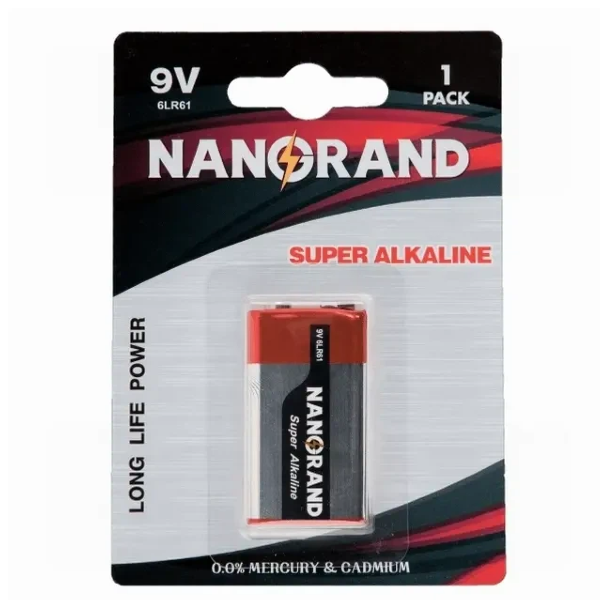
A 9V battery occupies a different position in the market because it delivers higher nominal voltage in one compact unit. Instead of requiring multiple smaller cells inside a device, a 9V battery provides that voltage in one familiar format. That can simplify product design and make replacement more straightforward for the user.
This is one reason 9V batteries continue to appear in products that need a distinct battery form and voltage level. Buyers often recognize 9V batteries immediately because the shape and connectors are different, and that difference signals a different type of use rather than just a larger battery.
9V batteries are commonly associated with products such as smoke detectors, selected toys, measuring tools, and certain portable household electronics. These are devices that are designed around the battery’s particular shape and voltage requirement rather than around a cylindrical battery compartment.
In many of these products, battery choice is not something users compare across several formats. The device already determines the answer. If the product takes 9V, then that is the format required. This is why 9V remains an important part of a complete battery range.
Voltage | Common Alkaline Formats | Typical Devices | Why It Fits |
1.5V | AAA, AA, C, D | Remotes, toys, flashlights, radios, speakers | Standard voltage for a wide range of household devices |
9V | 9V battery format | Smoke detectors, test tools, selected toys, portable electronics | Higher voltage in one compact and familiar battery |
12V | 23A, 27A | Garage door remotes, key fobs, smart locks, remote controllers | High voltage in a very small format for specialty controls |
When people hear 12V, they often imagine a much larger battery. But in the alkaline battery market, 12V can also come in compact specialty formats such as 23A and 27A. These small batteries are commonly used in garage door remotes, key fobs, wireless remote controllers, smart locks, and similar control devices.
These batteries matter because the devices using them are compact, but they still require a higher-voltage design. That is why standard 1.5V household batteries are not suitable substitutes. The device is built around a specialty battery format, and the battery must match it exactly.
This is where many buyers become confused. They see a very small battery and assume it can be replaced by another small battery. In reality, specialty remote-control products depend on precise voltage and size matching.
The compact 12V battery category is a good example of why battery size and battery voltage must always be considered together. These batteries are physically small because the products using them are small. At the same time, they are electrically distinct because those products need a higher-voltage configuration to function properly.
This combination makes them practical in devices where space is limited but voltage still matters. A key fob, garage remote, or wireless controller cannot usually accommodate large batteries, yet it still needs a power source designed for its internal circuit. That is exactly what 23A and 27A batteries provide.
For buyers, this means the right battery choice is not about using the nearest equivalent. It is about following the battery marking already specified by the product.
When voltage does not match the device requirement, problems appear quickly. In some cases, the device will not turn on at all. In others, it may operate weakly, respond poorly, or stop working reliably after a short time. A mismatched battery can also be physically incompatible even if it appears similar at first glance.
This is why voltage mistakes matter in the real world. They directly affect whether the product works, how well it works, and whether the buyer has actually purchased the correct replacement. Many battery problems begin with simple mismatching.
That is also why product education is so important. The goal is not to overload buyers with technical detail. It is to help them avoid preventable mistakes and choose the right battery the first time.
The quickest way to choose the right battery voltage is to begin with the device itself. The battery compartment, user manual, old battery label, or printed marking on the product will usually show exactly what is required. That instruction should always come before guesswork.
If the device is designed for 1.5V AA, then that is the correct path. If it requires 9V, the buyer should not replace it with another familiar size. If it uses 23A or 27A, the product is asking for a specialty 12V battery and should be treated that way.
Once the correct voltage is clear, the next step is choosing a battery that offers dependable performance, stable storage behavior, and practical quality. This is where NANGRAND’s battery range becomes relevant. The company produces multiple alkaline battery series, including standard 1.5V household sizes, 9V products, and 23A and 27A 12V batteries for control devices.
For buyers, that kind of range matters because voltage needs vary from one product category to another. Some customers need familiar household batteries. Others need compact remote-control batteries. A supplier that covers multiple voltage formats helps simplify sourcing and supports a wider range of end-use products.
Voltage matters because devices are designed around it, not because it looks impressive on the label. Once buyers understand the difference between 1.5V, 9V, and 12V, battery selection becomes much more practical and much less confusing. NANGRAND supports this everyday need with a broad alkaline battery lineup that covers common household power needs as well as specialty remote-control applications. If you are looking for dependable 23A 12V Alkaline Battery and other voltage-specific battery products for retail, distribution, or OEM cooperation, contact us to discuss your requirements and product opportunities.
No. A higher voltage does not automatically mean the battery will last longer. Voltage is mainly about what the device is designed to receive, while runtime depends more on battery format, capacity, and device power use.
Many common household devices are designed around 1.5V cells, including AAA, AA, C, and D batteries. The voltage stays the same, while the battery size changes to fit different runtime and device requirements.
They are commonly used in compact specialty devices such as garage door remotes, key fobs, wireless controllers, and smart locks that need higher voltage in a small battery format.
Buyers often need more than one battery format for different products. NANGRAND offers 1.5V, 9V, 23A, and 27A alkaline battery solutions to support a wide range of applications.


