- All
- Product Name
- Product Keyword
- Product Model
- Product Summary
- Product Description
- Multi Field Search


Views: 0 Author: Site Editor Publish Time: 2026-08-25 Origin: Site


The nominal "1.5V" printed on an alkaline battery is a historical standard rather than a constant operational metric. You might expect a steady power supply from a fresh cell. The reality remains far more complex in practice. In practical engineering, a battery’s output forms a dynamic curve. Internal resistance, discharge rates, and your host device's power management architecture heavily influence this downward curve. Relying blindly on the packaging label often leads to premature battery disposal. It can also cause unexpected equipment failures during critical operations. Understanding the physics behind voltage decline is critical for hardware engineers and power users alike. You need practical knowledge to match the right power source to your equipment. We will explore how different device architectures interact with voltage drops to maximize power efficiency.
Voltage is not static: Alkaline cells start around 1.6V and decline continuously; understanding the difference between "functionally dead" (1.2V) and "chemically dead" (0.8V) prevents premature disposal.
Device architecture dictates battery life: Devices with Switch-Mode Power Supplies (SMPS) draw more current as voltage drops, accelerating alkaline battery drain.
Open Circuit Voltage (OCV) is deceptive: Measuring a removed battery with a standard multimeter will show an artificially recovered voltage; accurate evaluation requires loaded measurement.
The Peukert Effect penalizes high drain: Alkaline batteries lose significant functional capacity in high-draw devices, making lithium or NiMH more viable for specific enterprise applications.
Most users expect an Alkaline Battery to output 1.5 volts continuously until it dies. This assumption is fundamentally incorrect. The 1.5V benchmark traces its origins back to the 1896 Columbia Dry Cell. It represents an average historical baseline rather than a modern operational guarantee.
Fresh alkaline cells typically measure between 1.50V and 1.65V unloaded. Upon connection to a load, the voltage drops immediately. Engineers call this initial decline the Internal Resistance (IR) Drop. The battery's internal components naturally resist the flow of electrons. This resistance converts a small amount of potential energy into heat. As a result, the working voltage dips the moment you turn the device on.
As discharge continues, the voltage decline accelerates due to two primary chemical factors. The first is activation polarization. This term describes the natural speed limits of internal chemical reactions. The battery simply cannot convert zinc and manganese dioxide into electrical energy fast enough under heavy loads. The second factor is concentration polarization. As the battery depletes, ions struggle to move through the thickening electrolyte. This difficulty further reduces the voltage delivered to the device terminals.
Different battery chemistries exhibit unique discharge behaviors. Unlike NiMH or lithium chemistries, an alkaline cell experiences a gradual, sloping decline. They do not maintain a flat plateau before dropping off a sudden cliff. This sloping profile means device performance will degrade predictably over time. Flashlights will dim slowly, and motors will turn sluggishly, rather than failing abruptly.
| Chemistry Type | Initial Voltage | Discharge Curve Shape | Failure Warning |
|---|---|---|---|
| Alkaline | 1.5V - 1.65V | Sloping, steady decline | Gradual dimming or slowing |
| NiMH (Rechargeable) | 1.2V - 1.4V | Flat plateau, sudden drop | Abrupt shutdown |
| Primary Lithium | 1.5V - 1.8V | Very flat, extended plateau | Sudden loss of power |
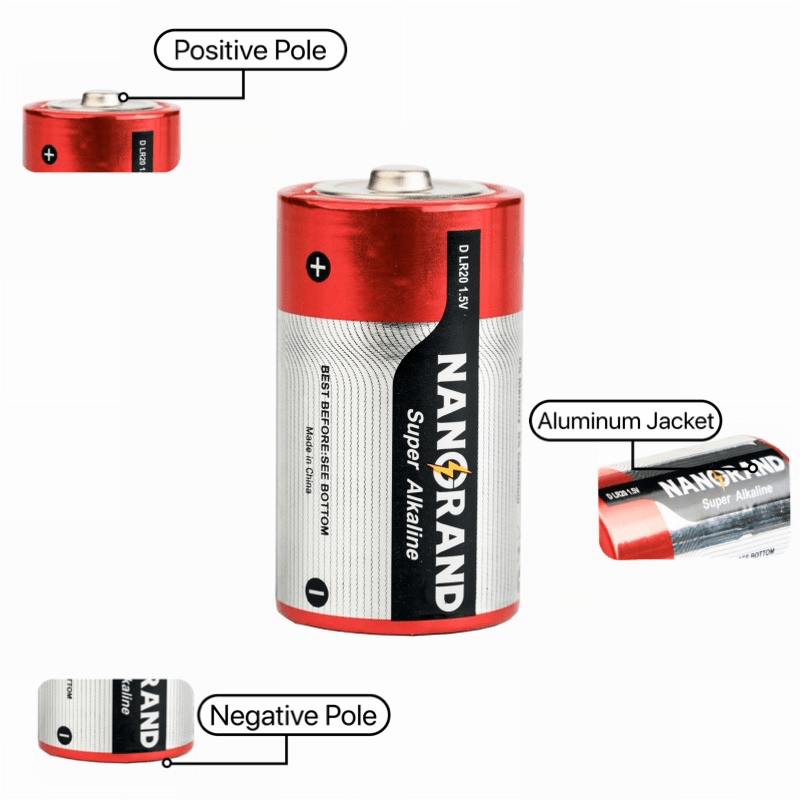
Your electronic device plays an active role in how quickly a battery depletes. The internal circuitry dictates the power demand. Understanding hardware compatibility explains why some gadgets drain batteries in hours while others last for years.
Legacy devices often use simple resistive circuits. Basic LED flashlights and standard analog clocks fall into this category. In these direct-drive circuits, current drops proportionally as battery voltage drops. The device simply dims or slows down safely. They do not force the battery to work harder. This passive relationship allows basic electronics to extract almost all available chemical energy from the cell.
Modern electronics operate quite differently. Digital cameras, smart home sensors, and advanced microcontrollers use Switch-Mode Power Supplies (SMPS). These internal regulators maintain a perfectly stable operating voltage for sensitive processors. Because they demand constant power, a drop in voltage forces the device to pull higher current. You can see this in the formula P=UI (Power = Voltage × Current). This dynamic creates a negative resistance characteristic. The device actively pulls more current to compensate for the weakening voltage. This accelerates heat generation and guarantees rapid battery depletion.
High-end devices integrate Under-Voltage Lockout (UVLO) circuits to protect sensitive components. Memory chips and processors can scramble data if they receive insufficient voltage. When high current draws pull the loaded voltage below a specific threshold, the UVLO circuit triggers a protective shutdown. This threshold frequently sits around 1.2V per cell. The device powers off entirely, even though substantial chemical energy remains trapped inside the battery.
Evaluating battery life requires distinct definitions for "dead." A battery might fail to power a digital camera but easily run a television remote for another year.
High-drain equipment sets a high bar for power delivery. Motorized devices and high-output wireless transmitters typically trigger their UVLO at 1.2V. When the voltage dips to this level under load, the Alkaline Battery is "functionally dead" for this specific application. It cannot sustain the required current. However, it still retains up to 40% of its original energy capacity.
Industry standards generally recognize 0.8V as the ultimate absolute cutoff. The physics of solid-state electronics dictate this floor. Silicon PN junctions require roughly 0.6V to 0.7V just to activate. Below 0.8V, even specialized DC-DC boost circuits fail to operate. Devices like Joule Thief circuits can extract trace power down to this level, but beyond 0.8V, the cell is chemically dead.
Organizations managing large equipment fleets should implement a structured reallocation strategy. Throwing away cells at 1.2V wastes enormous amounts of functional energy. You can maximize usage by following a cascaded demotion policy.
Phase 1 (High-Drain Use): Deploy fresh batteries (1.6V to 1.2V) in critical, heavy-draw equipment like digital cameras and motorized tools.
Phase 2 (Medium-Drain Use): Relocate the "functionally dead" 1.2V batteries to medium-draw devices like computer mice or portable keyboards.
Phase 3 (Low-Drain Use): Move the remaining cells (1.0V to 0.8V) into ultra-low-drain applications like wall clocks or basic IR remotes.
Phase 4 (Disposal): Recycle the batteries only once they hit the absolute 0.8V floor.
Battery capacity is rarely a fixed number. The rate at which you draw power directly changes the total energy you can extract. This scientific phenomenon dictates equipment performance across different industries.
Peukert’s Law states that a battery's available capacity decreases as the rate of discharge increases. Alkaline batteries suffer heavily under this law. They possess a high Peukert constant. This means high-drain devices fail to extract the rated milliamp-hour (mAh) capacity printed on technical spec sheets. A battery rated for 2500mAh at a low draw might only yield 1000mAh in a high-powered medical device.
| Discharge Rate / Application | Current Draw | Estimated Capacity Yield | Efficiency Loss |
|---|---|---|---|
| Low Drain (Clocks, Remotes) | 25mA | ~2500 mAh | Minimal |
| Medium Drain (Toys, Radios) | 250mA | ~1800 mAh | ~28% Loss |
| High Drain (Cameras, Motors) | 1000mA+ | ~900 mAh | ~64% Loss |
Heavy current draws create massive stress inside the cell. They face increasing internal resistance from reactive byproducts building up on the electrodes. This internal bottleneck converts potential electrical energy into wasted heat. Operating temperatures exceeding 50°C (122°F) can cause permanent performance degradation. Furthermore, excess heat vaporizes the internal electrolyte. This pressure increases the risk of corrosive electrolyte leakage, which destroys sensitive battery contacts.
Decision-makers must evaluate hardware requirements before purchasing bulk supplies. For continuous high-draw applications, you must weigh the low initial cost of standard cells against alternative chemistries. NiMH batteries offer a flat 1.2V curve and handle high current easily. Primary Lithium cells provide a stable 1.5V-1.8V flat curve with exceptional high-drain tolerance. Sometimes, stepping away from traditional chemistries prevents frustrating hardware bottlenecks.
Accurate testing separates usable inventory from dead waste. Unfortunately, most people use testing methods that provide wildly inaccurate results. Proper evaluation requires understanding how loads manipulate voltage readings.
Testing a "dead" battery immediately after removing it from a heavy load is extremely misleading. Once you remove the load, the internal resistance stops causing a voltage drop. The Open Circuit Voltage (OCV) can "bounce back" by 0.3V or more. A battery that killed a device at 1.1V might measure 1.4V on a desk. This falsely suggests the battery is healthy, leading users to blame the device for the failure.
Reliable evaluation requires testing the battery under a simulated load. You must match the load to the target device. Advanced battery testers use internal resistors to draw current while measuring the voltage.
Use dedicated testers: Choose testers that apply a load rather than simple multimeters.
Test in-device: Measure the voltage across the battery terminals while the device is turned on.
Understand the threshold: If loaded voltage drops below 1.2V, remove it from high-drain gear.
For advanced evaluation, engineers rely on momentary short-circuit current testing. You use a multimeter’s 10A setting to briefly bridge the battery terminals. This test provides better health insights than voltage alone. A fresh cell usually delivers an impressive 8-10 Amps of short-circuit current. A cell dropping below 2 Amps is strictly relegated to ultra-low-drain applications. If it shows less than 1 Amp, you should recycle it immediately.
Proper management extends shelf life significantly. You require disciplined environmental controls to protect your inventory.
Temperature control: Store inventory in cool, dry environments away from direct sunlight.
Heat avoidance: Extreme heat accelerates chemical self-discharge and increases failure rates.
Cold limitations: Freezing temperatures thicken the electrolyte. This temporarily cripples the voltage delivery until the cell thaws entirely.
Voltage in an alkaline battery is never a fixed guarantee. It operates as a measurable symptom of both the cell's internal chemical state and the external hardware's demand. Making effective engineering and deployment decisions requires looking past the historical "1.5V" label. You must evaluate how specific device architectures interact with the sloping discharge curve. We recommend implementing loaded testing procedures immediately to avoid the OCV trap. Furthermore, establishing a strategic battery reallocation policy will drastically reduce waste. These calculated adjustments prevent unexpected hardware downtime and maximize operational efficiency.
A: Not necessarily. While simple resistive devices will use less power as voltage drops, devices with modern voltage regulators (SMPS) will actually draw more current to compensate for the lower voltage, draining the battery faster.
A: You are measuring Open Circuit Voltage (unloaded). Once placed inside a high-drain device, the battery's internal resistance causes the working voltage to plummet instantly below the device's minimum operating threshold.
A: Rarely for commercial applications. Boosters consume energy to operate (conversion loss). While they can force an alkaline battery to output 1.5V until it is completely dead, they often disrupt a device's battery-level indicator and result in abrupt, unpredicted shut-offs.
A: No. Mixing batteries forces the fresh cell to drive current through the depleted cell's high internal resistance. This causes reverse charging effects, excessive heat, and a very high probability of hazardous leakage.


